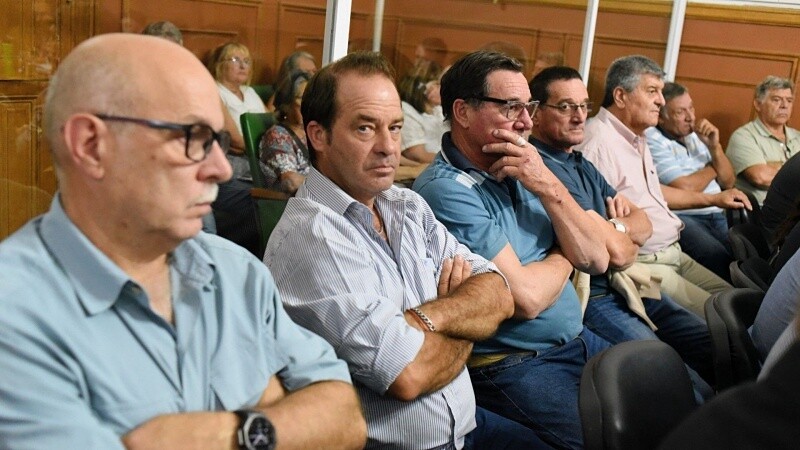
On Wednesday, February 4th, a trial began in the Federal Courts of Rosario to investigate the crime of pollution from agrotoxic spraying in the town of Pergamino, Buenos Aires province. The case has about a hundred witnesses, and on the defendants' bench are five agricultural producers and two former public officials, accused of omitting mandatory controls, one of whom is also charged with threats. In dialogue with El Ciudadano, they expressed hope that this will "set a very important precedent to bring order to the productive activity that is affecting human and environmental health." "We came to support the neighbor from Pergamino in a trial related to spraying with agrotoxics, we came to support the Mothers of Ituzaingo neighborhood who had a similar trial in Córdoba many years ago," they stated. During his presentation, he detailed the evidence presented in the case, which includes statements from police officers who verified the fields and the spraying, medical personnel who treated the victims and can define the common symptoms they presented, officials, professionals, workers, and neighbors of Pergamino. The accusations specify that they intend to demonstrate that the spraying actions were not private actions protected by the Constitution as another lawful industrial activity; but rather that "the specific way this agricultural activity did not begin and end on the land, in the field, in the plot" and "has as a consequence the contamination of the surface, the air, and the water, the death of animals derived from pesticides, and serious health problems for the inhabitants of Pergamino with common symptoms, from respiratory ailments to terminal illnesses." He spoke of "damage to existence," referring to what the victims of these types of actions in the fields around the city experienced. "That we have managed to bring them to the defendants' bench is an important milestone." From the Prosecutor's Office, the nature of the accusation was defined: "We are all victims." For us, this trial is very important because it is the first one at the federal level. For the environmental activist, this trial is also "a trial against a production model based on chemicals that has caused a lot of damage to the environment and people." On Thursday, February 5th, there will be another hearing, and throughout the month, three more: on the 12th, 24th, and 25th starting at 9 in the morning. The process is in the hands of the Federal Oral Court No. 2, made up of judges Román Lanzón, Elena Dilario, and Eduardo Rodrigues Da Cruz. One of the most visible faces of this case is Sabrina Ortiz, a complainant, victim of the spraying, and accuser since 2011, when she lost a pregnancy of almost six months. The prosecutor emphasized: "The truth accepted by science supports us." During preliminary measures, the defense attempted to obtain a probation (suspension of the trial on probation) but it was rejected. On the one hand, the defense raised various arguments, from considering that the facts under investigation are not within federal jurisdiction to indicating that the chemicals used also represent a cost to the producer or that the plots where chemicals were applied were very small and that there was no intent. In this first hearing, six of them were present in person and one followed it virtually. The prosecutor in charge is Federico Reynares Solari, in charge of the Area for Investigation and Litigation of Complex Cases, of the Strategic Oral Litigation Office.